Pakistan’s Historic Leap with Dual Space Milestone in 2026
Indigenous EO-3 Satellite and Pakistan’s First-Ever Astronaut Mission in 2026
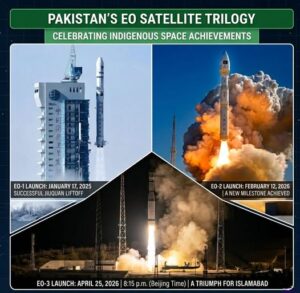
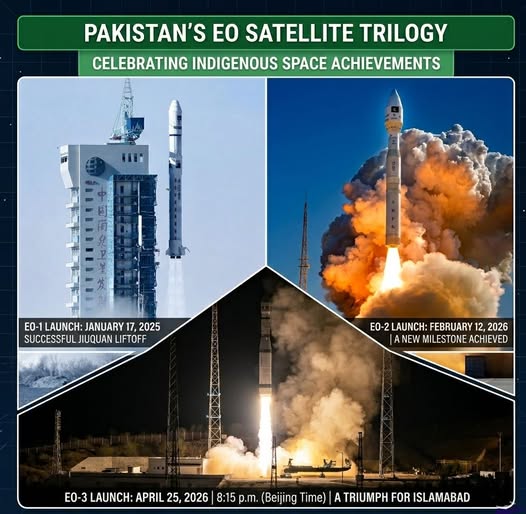
Pakistan has reached a defining moment in its scientific journey. With the successful launch of EO-3, the nation’s third consecutive indigenous Electro-Optical satellite, and the selection of Khurram Daud and Muhammad Zeeshan Ali as Pakistan’s first official astronauts, the country has simultaneously mastered Earth observation from orbit and committed to placing its own citizens among the stars. These twin achievements, born from decades of quiet perseverance and a landmark partnership with China’s Manned Space Agency (CMSA), signal that Pakistan is no longer a spectator in the global space arena.
The EO-3 Milestone: 3rd Pakistani Indigenous Satellite
The EO-3 satellite represents the maturation of Pakistan’s indigenous satellite manufacturing capabilities. As the third consecutive Electro-Optical platform developed and launched by SUPARCO, it builds upon the foundations laid by its predecessors while delivering significantly enhanced resolution, wider spectral coverage, and faster data turnaround. Where earlier missions proved Pakistan could design, assemble, and operate satellites, EO-3 demonstrates that the nation can do so repeatedly and reliably — a threshold that separates experimental programs from sustainable space infrastructure.
The practical implications are immediate and far-reaching. EO-3’s high-resolution imagery will sharpen agricultural monitoring across Pakistan’s diverse cropping zones, enable faster response to natural disasters such as floods and earthquakes, support urban planners managing rapid city expansion, and bolster national security through independent Earth observation. In a region where satellite data access has often depended on foreign providers, an indigenous eye in the sky is both a strategic asset and an economic enabler. It places Pakistan among a select group of nations, fewer than twenty worldwide, that can claim end-to-end satellite ownership, from design to operational deployment.
Khurram Daud & Muhammad Zeeshan Ali: Pakistan’s First Star Voyagers
While EO-3 extends Pakistan’s reach into orbit, Khurram Daud and Muhammad Zeeshan Ali are preparing to carry the nation into human spaceflight. Selected through a rigorous process that evaluated physical endurance, technical acumen, and psychological resilience, these two officers represent the culmination of a dream that has animated Pakistan’s scientific community for generations. Their training with CMSA will encompass spacecraft systems operation, extravehicular activity protocols, long-duration mission psychology, and Mandarin language proficiency — a comprehensive preparation for life aboard the Tiangong Space Station.

What distinguishes this mission beyond its technical dimensions is its symbolic weight. Daud and Ali do not train merely as individuals; they carry the aspirations of over 240 million Pakistanis. For a nation with one of the world’s youngest populations, the sight of Pakistani astronauts in space offers a powerful counter-narrative to stories of limitation and dependency. Their journey to Tiangong, facilitated by the deepening space cooperation between SUPARCO and CMSA, also represents a new model of international partnership — one built not on aid but on mutual capability and shared ambition.
What This Means for Pakistan’s Future ?
These milestones are not endpoints but launchpads. The EO-3 program establishes a replicable foundation for future satellites, weather platforms, communication relays, and eventually navigation capabilities, while generating high-skill employment in aerospace engineering, precision manufacturing, and data analytics. Simultaneously, the astronaut program creates institutional knowledge in human spaceflight operations that no textbook or consultancy can provide. Together, they position Pakistan to participate meaningfully in the rapidly commercializing global space economy, estimated to exceed one trillion dollars by 2040.
More profoundly, this dual achievement reshapes national identity. A country that can place its own satellites in orbit and train its own citizens for space station missions is a country that has crossed a threshold of scientific self-confidence. For students in Lahore laboratories, engineers in Karachi workshops, and researchers in Islamabad institutes, the message is unambiguous: the tools of space exploration are no longer beyond reach. The stars, once distant, now feel like the next frontier, and Pakistan is finally on its way to meet them.
About Author